Treasure Island: A BabyLit Shapes Primer by Jennifer Adams, Illustrated by Alison Oliver

Treasure Island

Yo, ho, ho and a bottle of chocolate milk! It’s another book that I had to buy because the Imp loved the library copy so much. The Giant and I are quite into pirates and so we’ve been introducing them to the boy.

Like all of the BabyLit books, this one focuses on one concept – shapes. The Imp has learned such 2-year-old improbable words as octopus, diamond, oval, crescent and, his favourite, jolly roger. Each 2-page spread has a white picture of the shape on a coloured background with the word below on the left and a Treasure Island-themed picture using that shape on the right (treasure map, Long John Silver, ship, etc.).

While the style of the artwork isn’t my favourite (I’m a girl who likes super-cute), it’s bold and striking but simple, which makes it easy to point out the shapes in the picture and to find details like the various jolly rogers and octopi throughout. This book is a triple threat – exposure to a classic, colours practice and an introduction to shapes, including more complex ones.

Library Fairy by Rebecca BenderReviewed by The Library Fairy

(review copy personally purchased).

How Santa Got His Job by Stephen Krensky, Illustrated by S.D. Schindler

How Santa Got HIs Job by Stephen Krensky
How Santa Got His Job by Stephen Krensky, Illustrated by S.D. Schindler

This book is all about what Santa did before he became Santa Claus. I picked this book because I grew up reading it. I like when Santa is looking for different jobs, and seeing what problem he has with each one. In the story Santa worked as a chimney sweeper, a delivery guy, a cook,
at a zoo and in the circus. The funniest thing in the book is the pictures. Elephant by Rebecca BenderIf I could change one thing it would be the way Santa found the elves. This is a good book!

Reviewed by Erin.

***

How Santa Got His Job has been with our winter/Christmas books for so long I actually don’t recall how it ever came to be there. I think it was part of a batch of winter themed books that came together in a Scholastic book order many years ago. I have always enjoyed the books humorous and original take on the whole Santa thing, especially at a time of year when it can feel like every book is just the same story told in slightly different words. Here we meet him as just another guy, trying to find and keep a job.

I quite agree with Erin, the section of the story with the elves is the one part that seems a bit forced. Most of the connections are more “believable.” For example, while working as a delivery driver Santa gets frustrated by traffic woes and starts doing deliveries at night when the roads are clear. Customer satisfaction becomes an issue and he is fired, but it sets up a logical segue to both his delivery skills and his propensity for night shifts.

All in all, both the text and the illustrations make this a fun non-traditional addition to the holiday reading tradition.

Turtle by Rebecca BenderReviewed by Susan Jean

(review copy personally purchased).

Chloe the Kitten (Fairy Animals of Misty Wood) by Lily Small

Chloe the Kitten by Lily Small

Chloe the Kitten is a fairy animal who lives in Misty Wood. Her job, as a Cobweb Kitten, is to help make Misty Wood beautiful by decorating all the spiderwebs with glittering dewdrops. One morning she wakes up late and nearly misses the window of opportunity to collect her bucket of dewdrops from the dewdrop fountain. Receiving help from a friend she successfully completes her day’s work only to discover that someone has come along afterward and stolen the dewdrops off the webs. It turns out the thief is only a thirsty little mouse who’s lost. Chloe determines to help her new friend find his family even though he lives by the lions and she’s afraid of the danger they may encounter.

Chloe the Kitten is the first book of the rapidly expanding Fairy Animals of Misty Wood series by Lily Small. Its cover, with a cute fairy-winged kitten and embossed shining silver sparkle, is a sure magnet for many a young reader. My five-year-old daughter eagerly brought it home from the bookstore and begged to read it with me immediately. We curled up on the couch, read the first chapter, then the next, and the next, until we finished the whole book in about an hour!

There are many strengths to this book. Lily Small invites readers into a truly wondrous world– a world in which every fairy animal plays an important part, care for creation is a core aspect in everyday activity, and friendship and kindness are encouraged in spite of worry and fear. Sentence structure is simple and appropriate for early readers yet the simplicity does not distract from other elements of the story. Chapter endings are especially strong, raising a question or concern over the next course of action. It’s difficult to stop reading when one’s curiosity is so peaked.

The  one weakness I’d attribute is the lack of Chloe’s contribution to problem-solving in the story. When it comes to the missing bucket, it’s a friend who provides a solution. When it comes to finding the mouse’s family, for all of Chloe’s attempts and tries, it’s the Wise Owl who conveniently makes it happen. Chloe, as a main character who means well, should have had a more direct role in discovering the location of the  “lions”.

All in all, Chloe the Kitten is an excellent book (perhaps most strong as a stand alone from the rest of the series). It’ll capture the heart of any reader that likes cute animal critters, fairies, forests, glitter and pretty.

Reading in the Woods by Rebecca Bender ResizedReviewed by K.C. Darling

(review copy personally purchased).


Hippos Go Berserk! by Sandra Boynton

Hippos Go Berserk by Sandra Boynton

My library recently asked staff to help with a display for “Books That Changed Your Life.” Hippos Go Berserk! was one of my picks! It may be overstating it a bit, but I feel like this book brought us together as a new family.

We had received one of Sandra Boynton‘s other great books, Are You a Cow?, when the Imp was born. I had already known how great Boynton is, but the Giant hadn’t encountered her before. Even though we were exhausted and confused new parents, he said that we should go to our awesome local children’s bookstore and get some more of Boynton’s books. So that was one of the Imp’s first outings, at about a month old.

We purchased Hippos Go Berserk! and life would never be the same – the Imp loved it! We read it so often that we can recite it by heart, we’ve read it backwards, the Giant made up a jazzy, Sinatra-esque tune for it and we’d sing it in the car… Once I was back at work, the Giant was still reading it so often that he started noticing little details and making up back stories for the hippos – “Look at that one’s sidelong look, he’s thinking ‘Oh no, it’s the Johnsons again!'” He pointed out that the 9 hippos who come to work go about their jobs soberly and diligently, so therefore all the hippos do not, in fact, go berserk. And he’s concerned that the last 2 hippos have stolen hippo #1’s wheelbarrow. So it makes the two of us laugh together, too.

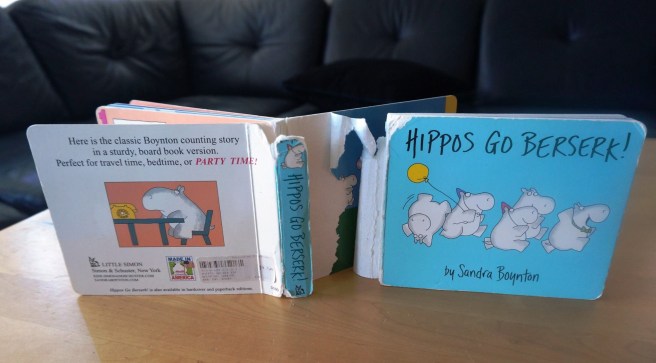
The Imp always, always smiles when we get to the berserk page and will sometimes turn the pages on us in mid-sentence to get there faster. Now that he’s starting to learn more words, he likes pointing to the numbers and also the page with the moon and the tree. I’m so pleased that the book is growing with him (most board books have a limited shelf life) and it’s been so well-loved that we recently had to buy a new copy, because the original looked like this:

A Well-Loved Copy of Hippos Go Berserk
Our well-loved copy of Boynton’s Hippos Go Berserk!

How about you? Do you have a favourite Boynton book? What are some fun ways you’ve jazzed-up story times? You’re comments are welcome!

Library Fairy by Rebecca BenderReviewed by The Library Fairy

(review copy personally purchased).

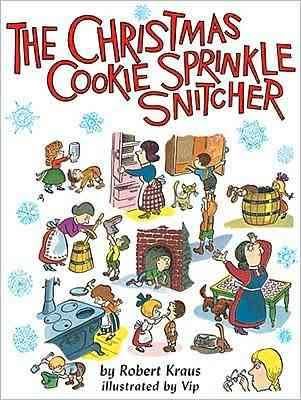
The Christmas Cookie Sprinkle Snitcher by Robert Kraus, Illustrated by Vip


The Christmas Cookie Sprinkle Snitcher by Robert Kraus
Originally published in 1969, reissued in hardcover 2010


Elephant by Rebecca BenderThe Christmas Cookie Sprinkle Snitcher is a good book with 3 or 4 stars. In the book the Snitcher is just someone who doesn’t understand Christmas and tries to find his own way to have fun. I think it’s a really good book and it used to be my favourite.

Reviewed by Erin

***

This was my absolute favourite book the year I was in kindergarten. I really hate to date myself, but that was quite some time ago now, back in the early 70’s. I can still remember the ball of eager anxiety that would form in my stomach as we sat on the carpet for story time in the school library. Would I be able to find my beloved book before anyone else got to it?

Years later I decided to track the book down and share it with my own kids. That’s when I found out The Christmas Cookie Sprinkle Snitcher had been out of print for years, and second hand copies where selling for over $400! Fortunately Purple House Press, a small publisher dedicated to “rescuing long lost but well-loved children’s books,” took up the cause and the book is back in print.

So, some 40 plus years later, how has my once favourite book stood the test of time, and changing perspectives? About as well as most memories once idolized I’m afraid.

The Christmas Cookie Sprinkle Snitcher tells the tragic tale of a town bereft of sprinkles for their Christmas cookies, all snatched by the sneaky Snitcher. When the entire population, including the chief of police, gives way to despair, a “plucky kid named Little Nat” takes matters into his own hands, and sets out to confront the Snitcher and save the baking season since…

“Christmas cookies without sprinkles

Are like raisins without wrinkles,

And like sleigh bells without tinkles

Are Christmas cookies without sprinkles.”

As you can see, the story is told in rhyme, which is both its charm and its downfall. If you put your literary glasses on, you will choke to death. BUT if you take the combination of trite and forced rhymes and the strained scansion as part of a quirky charming idiosyncratic package, then it all fits together.

Where the book still really shines is in its wonderful illustrations. Those who take the time to notice will find lots of amusing details in the pictures, which have aged better than the text. (Or survived my aging better than the text, depending on how you want to look at it.)

The Christmas Cookie Sprinkle Snitcher will always hold a place in my heart, and on my bookshelf, and I really do think it is still a fun read as long as you don’t try to take it too seriously and just let the quirkiness of the text become part of the charm.

Turtle by Rebecca BenderReviewed by Susan Jean

(review copy personally purchased).

The Whale in my Swimming Pool by Joyce Wan

Whale in Pool

I discovered Joyce Wan‘s adorable, charming board books not long before I had the Imp and they were a staple of his babyhood. We still read them sometimes, especially the yummy You Are My Cupcake. So I was delighted when I found out that she was writing her first full-length picture book! I love her style, which she describes on her website: “I am inspired by Japanese pop culture, Scandinavian design, modern architecture, and everyday things that make me smile. In my perfect world everything would be cute, round, and chubby.” Hey, that’s my perfect world, too!

This is a whale of a book for summer reading, with large, cute, cartoon-like illustrations and a fun story. I just love the whale – as you can see from the cover, he’s so happy and content to hang out in the tiny pool. He’s such a mellow whale. The little boy’s increasing frustration and attempts to get the whale out of the pool are funny and a compromise in the end makes everyone happy… until the boy discovers another creature has taken over inside the house. There are some touches that make it fun for grown-ups, too, including a shark fin in the pool next door and his mother’s completely oblivious response when he tells her about his dilemma. Even the endpapers are charming, with the whale at the beginning and the new animal nuisance at the end.

I’m definitely looking forward to more large-scale stories from Wan – maybe a winter one for next Christmas! 🙂

Library Fairy by Rebecca BenderReviewed by The Library Fairy

(review copy from library).

Sometimes I Like to Curl up in a Ball by Vicki Churchill, Illustrated by Charles Fuge

Sometimes I Like to Curl Up in a Ball by Paul Fuge and Vicki Churchill

Sometimes I Like to Curl up in a Ball is a beautifully illustrated board book that’s both fun and sweet. Each page is a delightful exploration of all the things Little Wombat likes to do:

Sometimes I like to jump high as I can, to see how much noise I can make when I land… Sometimes I like to stand still as a tree, and watch everyone rush around about me.

The energy and activity in the story is fluid and fresh, moving with ease from one moment to the next, but not always in the most expected ways (“Sometimes I like to scream ever so loud, Not that I’m cross, I just like how it sounds.”) Little Wombat can get up to some busy, noisy, and messy play but it’s all good-natured, honest exploration and delight in new discovery. I like that Little Wombat finds equal fun in “standing still” and in “running ever so fast” and that Little Wombat acknowledges “I sometimes come first, but I sometimes come last.”

There’s one spot where I feel the text loses its strength, where I’ve often been thrown off rhythm when reading out loud, but I’ve learned to remedy this by omitting a word (“Sometimes I like to just walk round and round, I pigeon step, pigeon step, till I fall down.”) I must confess that I also say ‘until’ rather than ’till’. For me, this makes for a better read.

Apart from the text, the illustrations offer extra layers of story–particularly in the area of Little Wombat’s relationships. Here we meet his friends and see how they participate in– or are effected by–Little Wombat’s antics. Charles Fuge flawlessly infuses humour and beauty into the story bringing to life the most meaningful moments.

Whatever activity occurs in a day, when the sun starts to fall Little Wombat does what he does best of all: he “finds somewhere soft, somewhere cozy and small and that’s where [he] like to curl up in a ball.” And that, of course, is at home nestled in the arms of Mama.

My primary appreciation of this book is that it helped make a book-lover out of my resistant reader. Granted, my daughter was young–not yet two– but she would push away books whenever we tried to read with her. I began to wonder if this would be a long-term tendency and (honestly) became a little lazy with my efforts, waiting for her to be the one to express interest. Her dad, however, persisted. Instead of trying to simply read the book (which she’d push away) he had our son come and act out what Little Wombat did. As my husband read, my son would curl up, jump, land, scream, walk in circles, fall down, stand still, poke out his tongue, make funny faces, mime a mess of his hands and chest, run fast, and finally curl up in a cuddle. My daughter loved this! And it was our daily routine until she eventually opened up to all sorts of stories.

My kids have since grown beyond board books, but this one remains on our shelf and still comes out every once and a while. It’s a keeper.

Reading in the Woods by Rebecca BenderReviewed by K.C. Darling

(review copy personally purchased).


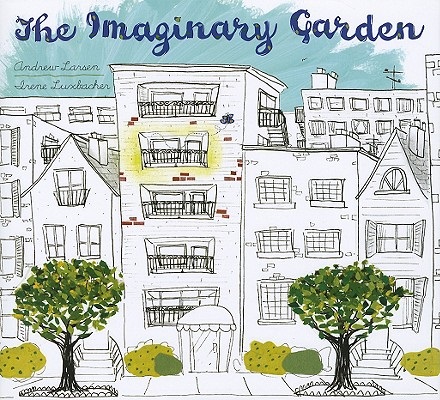
The Imaginary Garden by Andrew Larsen, Illustrated by Irene Luxbacher

The Imaginary Garden by Andrew Larson
The Imaginary Garden by Andrew Larsen, Illustrated by Irene Luxbacher

This picture book tells the story of Theo and her grandfather, who have always loved gardening together. When Poppa’s move to an apartment forces change, they find a creative and colourful way to transform his new balcony into an imaginary garden. When Poppa has to be away for a while, he leaves Theo in charge. She not only tends the garden, but adds a thoughtful surprise.

Things I love about this book:

I love the close relationship between Theo and her grandfather. I love that they take pleasure in facing the challenge of the missing garden. I love the touches of humour, like when Poppa buys them new gardening hats to wear as they work on painting their imaginary garden. Or when Poppa announces spring’s arrival by painting a robin, which Theo promptly feeds by painting a worm.

I love that Theo is empowered by her grandfather’s trust in her ability to both tend the garden according to plan, and to listen to her own heart and discern what needs done. I love that, in this age of instant gratification, their project takes time to complete, and I love Irene Luxbacher’s illustrations, which capture the feel of the story so well. And I also love the way gentle everyday teaching is completely integral to the story. (NOT cleverly hidden, just naturally there.)

For example, when Theo and her grandfather begin to paint they start with the garden’s back wall, because “the vines will need to hold onto something as they reach for the sun.” Later Poppa teaches Theo to mix black and white paint to make gray for the bricks. Similarly he describes how to make brown for the soil. BUT the story does not suddenly get dropped or side-lined in favour of a plant physiology class or colour blending lesson with example after example. Ideas are introduced only to the extent they are part of the story.

In a similar way, we learn a bit about what order spring flowers appear in, and what colours and shapes they are. When the spring robin “appears” it is revealed step by step as Poppa uses simple shapes and brush strokes to create it. A slightly older child might like to try following those steps to make their own robin.

In that way I think this book is especially wonderful for reading when there are slightly older and younger children listening at the same time. A younger child could follow the story, while an older one might find lots to think about besides just the story itself. The book would also lend itself as an introduction to a variety of activities (painting, planting seeds, going for a walk to look for and name spring flowers, learning about bird migration etc.)

Is The Imaginary Garden perfect? Of course not. That’s another one of the things I love about it.

Turtle by Rebecca BenderReviewed by Susan Jean

(review copy from personal library).

Put on Your Shoes by Dan Stiles


Put on Your Shoes by Dan Stiles

When I read a review of this board book that mentioned Stiles’ retro-modern art style, I knew I wanted to see it. I asked for it to be ordered for the library.

Bringing Put on Your Shoes! home, I suspected that I’d like it more than the Imp. I was ready for his signature shove-away move. But to my surprise, he loved it! It became such a favourite that we had to buy our own copy. He was in a shoe-obsessed phase at the time, so that made it even better! We’re still at the point where we put the Imp’s shoes on for him, so we don’t have the “Put on your shoes”/”No!” battle too much, but I’m sure that we will very soon and you can tell that Stiles has had this struggle himself.

As I expected, I do love the retro style and bright colours. It’s a very cool-looking book that appeals to adults as well as little ones. I love that it shows the child’s wild imagination (one of the reasons she can’t put on her shoes is that she’s caught in a tornado) and the parents’ patience with her. The big people in the family are shown from the toddler’s point of view, that is, only their legs and feet. The humour and here-we-go-again ending are such fun and there’s lots to see in the illustrations. The Imp loves to point out the rug (or rather, “wug”) on each page and little details like a frog and a tornado-tossed car.

Stiles has a new board book out called Today I’m Going to Wear… and I can’t wait to get my hands on it as well!

Reviewed by The Library FairyLibrary Fairy by Rebecca Bender

(review copy personally purchased).

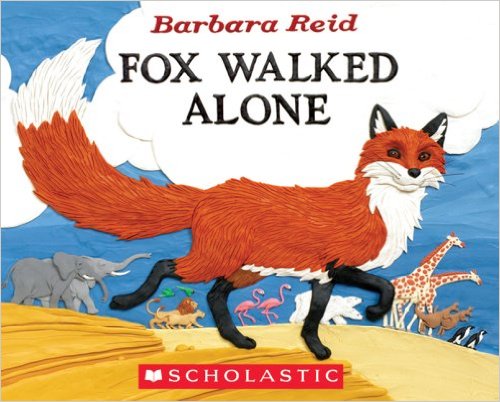
Fox Walked Alone by Barbara Reid

Fox Walked Alone by Barbara Reid

Fox Walked Alone is one of my favourite books. The Plasticine pictures look like they come off the page. I like how more and more animals keep coming into the story. I also like how Fox finds a partner at the end. I hope Barbara Reid writes another story about Fox and his family.

Reviewed by Eagan

***

I clearly remember my first encounter with Barbara Reid’s Fox Walked Alone. I was at an author/illustrator’s breakfast hosted by the Vancouver Children’s Literature Roundtable. Barbara was a featured guest speaker. Standing at the book table, I was drawn to its title and captivated by the cover image of a stunning red fox etched out of Plasticine, of all things. Without any further context for the story I began to read:

Night after night, Fox walked alone,

Came home to a bed made of feather and bone.

He hunted at night and slept through the day,

Fox walked alone, he liked it that way.

However, when Fox wakes up he senses something strange. Then animal after animal begins to journey past him. At first, Fox follows at a distance and safely out-of-sight, wondering what’s going on. But as the story progresses so does Fox’s sense of urgency.

Fox walked until his paws were sore–

He’d never walked so far before…

The sky was odd, the wind was wrong.

Fox thought he’d better tag along.

From the first page through to the last, I am caught up in the mystery. What’s going on? I feel compelled, like Fox, to follow. And by the end of the book, a narrative I know so well (Noah’s Ark) is fused with new life and energy, wonder and expectation.

After countless readings with my kids, Fox Walked Alone never fails to stir this skin-tingling anticipation within me. I’m tempted to keep talking (and raving!) about the book, but I will leave off discussion of some of my other favourite components of the story, such as the ravens and the doves, in order to allow you to discover and experience this wonderfully rich, multi-layered narrative on your own terms. It is one of those rare gems, a must-buy book.

Needless to say, I love this story! (And after reading Eagan’s review I realize, for him, it’s also very much a love story).

Reading in the Woods by Rebecca BenderReviewed by K.C. Darling

(review copy personally purchased).