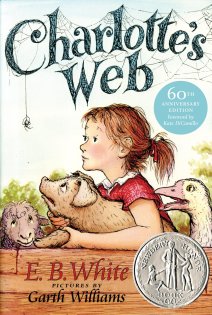
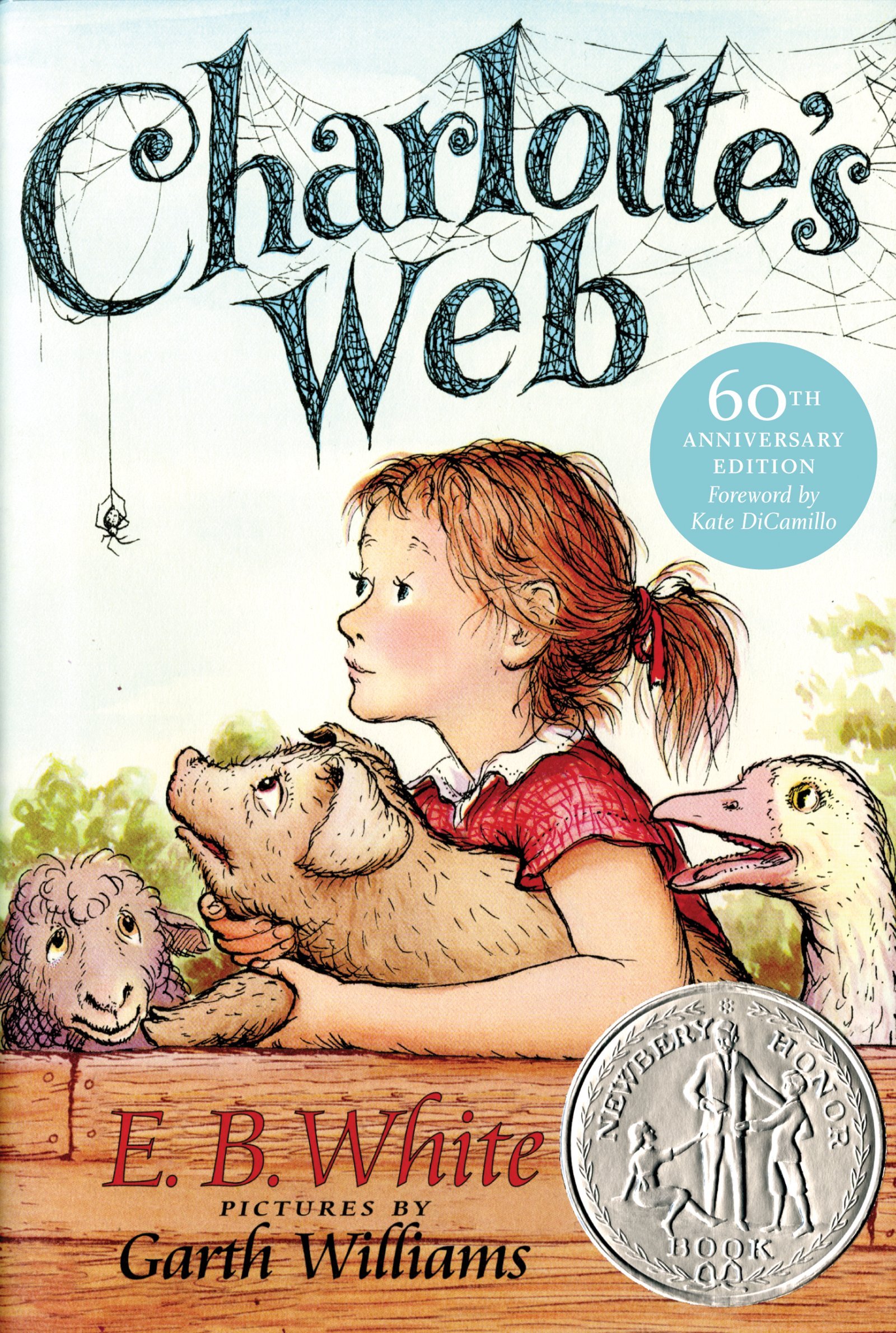
 In E.B. White’s 1952 children’s classic, Wilbur is a runt of a pig whose life is spared from the ax when a young girl named Fern intervenes on his behalf. Under her care he grows up strong and healthy. Wilbur is sold then to a neighbouring farm where he is befriended by a spider named Charlotte. When Wilbur learns he is being fattened up for killing Charlotte determines to help save him. Here, Charlotte shows us just how powerful and important stories are!
Charlotte weaves the words ‘some pig’ into her web, and from then on Wilbur’s world forever changes. He transitions from being a pig fit only for slaughter to a pig that’s prized:
“You know,” [Mr. Zuckerman] said, in an important voice, “I’ve thought all along that that pig of ours was an extra good one. He’s a solid pig. That pig is as solid as they come. You notice how solid he is around the shoulders, Lurvy?” / “Sure. Sure I do,” said Lurvy. “I’ve always noticed that pig. He’s quite a pig.” / “He’s long, and he’s smooth,” said Zuckerman. / “That’s right,” agreed Lurvy. “He’s as smooth as they come. He’s some pig” (81-82).
Charlotte’s strategy for saving Wilbur embodies the power of story. Her words—her story—remake reality for Wilbur. Charlotte’s writing (‘some pig’) intervenes in the current situation (a world in which a pig is a pig, intended for dinner, not deserving of special attention) and alters it (Wilbur is now some pig and visitors arrive from all over the county to look at him). This ‘new reality’ not only envelops Wilbur, but the Zuckermans, Lurvy, and their entire community as well: “All said they had never seen such a pig before in their lives” (84).
Yet Charlotte’s writing does more than alter people’s perception of a pig. It also alters the pig’s perception of itself, Wilbur’s own sense of identity. Twice Wilbur objects to Charlotte’s plan to write, in reference to him, the word ‘terrific’ in her web. “But I’m not terrific, Charlotte. I’m just about average for a pig,” he says (91). For Wilbur, at this point in time, Charlotte’s story isn’t true. Yet the very next day “everybody stood at the pigpen and stared at the web and read the word, over and over, while Wilbur, who really felt terrific, stood quietly swelling out his chest and swinging his snout from side to side” (96, italics added). Charlotte’s story brings about a shift in the way he feels about himself and, in turn, Wilbur’s sense of identity is altered. Enough so that when Charlotte discusses using the next word (‘radiant’), Wilbur immediately declares, “I feel radiant” (101). What Charlotte speaks and writes of Wilbur directly informs his sense of self. And Wilbur not only has Charlotte’s initial rendering of him as some pig, terrific, radiant, and humble but he also has the countless retellings. Charlotte’s words are repeated, restated, and reaffirmed on multiple occasions by Mr. and Mrs. Zuckerman, the Arables, Lurvy, the minister, the fair announcer, and various members of the crowd.
What’s more, in addition to altering perceptions and identity, Charlotte’s writing alters actions and behaviour. Wilbur takes to behaving ‘radiantly’ by performing flips and twists in the air and walking with a spring in his step (115). Mr. Zuckerman, in appreciation of his terrifically radiant pig, bans manure from the pigpen, orders fresh straw for each day, gives Wilbur better feed and buttermilk baths, and decides to enter Wilbur in the County Fair (84, 96, 150). This former runt of the litter wins special recognition at the Fair and, in the end, will live out the rest of his life without the fear of becoming Christmas dinner. Indeed, Charlotte’s story intervenes into Wilbur’s current situation and alters it.
Charlotte shows us that our words—our stories—have the power to shape perception, identity, actions, and behavior. Both Charlotte and E.B. White demonstrate the power of story to ‘remake’ reality. We at Runcible Review look forward to sharing more about the stories and storytellers that help shape the way we see and understand ourselves and the world in which we live.
Thanks for joining us!
 Reviewed by K.C. Darling
(review copy from personal library)




 Runcible Review